by Sarah Semark of Triggers & Sparks
Bad clients are notorious among designers. We complain about them constantly, we’ve devoted a hilarious, yet-heartbreaking website to them, and we swap horror stories like badges of honour, rolling our eyes in empathy and disgust.
We spend so much time complaining about the bad clients that it’s sometimes easy to overlook the good clients. Lately, I’ve been working with a few really great clients, and I’ve been so happy because of it. Where a bad client can make you feel as though you’re losing your soul, a good client reminds you of why you fell in love with design in the first place and makes you feel as though you’re doing a good job. It’s the sort of warm-fuzzy feeling I associate with boys who bring me flowers and strangers complimenting me on my shoes.
Winning your designer’s love, regardless of any other factors, will mean that you will receive a level of service and quality that surpasses that most Troublesome Clients receive. When I love a client and feel that my client respects me as a professional, I invest more of my mental energy into their project. A good client makes you want to do an amazing job, whereas a bad client experience will often just make you want to finish as fast as possible and get the heck out.
So, how do you go about making sure you’re the greatest client ever, and ensuring your designer feels as passionate about your project as you do? Here, a few tips culled directly from my Dream Clients:
1. PAY YOUR BILLS AS FAST AS HUMANLY POSSIBLE
Nothing says “you’re not worth much to me” like a leisurely bill payment. Freelance designers suffer so much stress about unpaid bills and cash flow, it’s hard when you don’t have a regular stream of income, that late-paid bills are a major problem.
I have one client in particular who sends me a full payment, via electronic means, within 24 hours of receiving an invoice. Every time it happens, I am utterly delighted. The rapid work-reward cycle means that I feel more compelled to finish work rapidly, knowing that I’ll be rewarded immediately upon completion. If, on the other hand, it takes more than a month to put a cheque in the mail (there is a due date on there, you know!), I’m going to feel much less inclined to speed through the project.
Freelance designers are not the power company—if you don’t pay us, we can’t eat (or buy pretty shoes)! Pay your bills promptly, please.
2. KNOW WHAT YOU WANT
It’s your designer’s job to gently guide you and to help you figure out what you want, then create a visual representation of your needs. If you approach a project without knowing what you want, the whole process goes to hell. Essentially, if you don’t know what you want (you don’t need to have every detail planned out, but you do need a rough idea) I can’t figure out how to build it for you. It’s like if you were to hire an architect to design you a house; you’d want to figure out how many bathrooms you want before asking for blueprints.
Beware the phrase “you’re the designer”, as in “Well, you’re the designer, you figure it out!”. While this is usually used with good intentions it will make the vast majority of designers cringe. To us, it sounds like you’re saying “you’re the magician!” (see also: “Can’t you just Photoshop that?” Design is not magic; Photoshop is not a magic button. It’s mostly work, training, and lots of patience).
3. UNDERSTAND THAT YOUR DESIGNER KNOWS WHAT THEY ARE DOING (and that’s why you hired them, right?)
This directly contrasts the “well, you’re the designer!” mindset, and clients usually tend towards one extreme or another, where a balance is really preferable. A micromanaging client, however, will almost always be less popular than a hands-off client. This is an almost guaranteed way to make your designer want to throw himself off the nearest bridge, skyscraper, or touristy landmark.
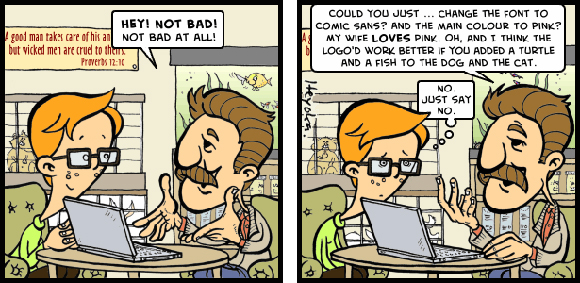
Of course, there’s a fine line between giving feedback and micro-managing. How to tell the difference? If you’re into the sixth round of revisions, and all the revisions read something like so: “Make the logo 40% bigger, and move it 3 inches to the right. Make the text all white, and the background purple. Headings should be right-aligned and in 4pt red Comic Sans. Can we add a few animated gifs throughout the page in order to make it ‘pop’?” (Please note: often these sorts of phrases are then followed by “Well, you’re the designer! Can’t you just make it look better?”).
Remember: you hired your designer (I hope!) because you think they do great work and know what they’re doing. They’ve probably been building websites longer than you. While ultimately the final judgement call is yours, realize that a good designer will work with you to give you a final product that both suits you and your business and also looks good. Remember that we have your best interests in mind and give us enough freedom to create something beautiful for you.
4. COMMUNICATE EFFECTIVELY
The client-designer relationship is much like any other relationship: emotions are involved, everyone’s a little nervous to begin with, you need to make sure everyone’s happy and nobody’s being taken for granted, etc. This is why, of course, good designer-client relationships generate brilliant work, and bad ones leave all parties unhappy. So, like with any other relationship, good communication is vital. Make sure you’re being clear about how you feel and what you want, and treat your designer with respect and consideration (this means no phone calls at 2am, no matter how dire you think the emergency is. In theory, I am sleeping then.) Your designer needs your feedback in order to know that they’re on the right track—make sure that you can give useful, constructive feedback in a timely manner.
And when all else fails, sending presents works, too. I once had a client who mailed me a box of chocolate brownies when my computer died in order to “aid the recovery process”, and another client who made me a heart-shaped chocolate cake. Chocolate generally engenders love and loyalty, but really, all that’s required is a polite thank you for a wonderful job, and I’ll move mountains for you.